
H1NTED
Pre-Communication Personalization for Robots and AI Agents
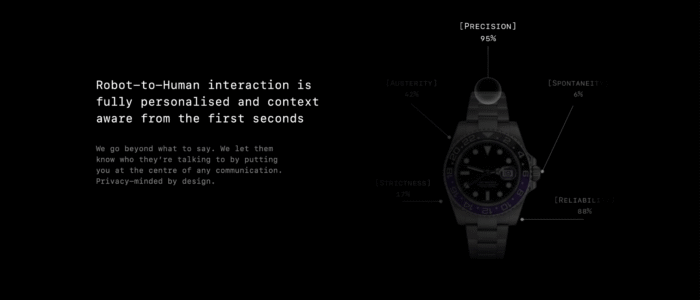
H1NTED provides pre-communication personalization for robots and AI agents. Before an interaction begins, it looks at visible, non-identifying cues such as a person’s appearance and accessories. These visual signals are processed through H1NTED’s system to create a prompt that helps the robot or AI agent decide how to communicate with that person.
H1NTED does not need surveys, accounts, or previous user data. Instead, it uses real-world visual signals to understand and adapt to people in real time, providing AI personalization and AI behavioral personalization.
This allows robots and AI agents to personalize their communication from the very first interaction. H1NTED continuously self-validates its understanding to keep the interaction adapted to the person, supporting personalized AI agents and human-robot interaction.
Key Highlights
- Pre-communication personalization: Uses visible, non-identifying signals to personalize robots and AI agents before an interaction begins.
- Real-time adaptation: Uses real-world visual signals to adapt communication without surveys, accounts, or previous user data.
- Personalized AI agents: Creates prompts that help robots and AI agents decide how to communicate with each person.
- Human-robot interaction: Helps robots personalize communication from the very first interaction.
Frequently Asked Questions (FAQs)
1. How do I give an AI agent useful user context before it starts taking actions?
An AI agent needs relevant information about the person before it can personalize its first interaction. One way is to provide context from available, non-identifying signals before the conversation begins. H1NTED takes this approach by analyzing visual signals such as appearance and accessories and turning them into a prompt for the agent. This is its pre-communication personalization approach.
2. Should an AI agent ask for user context upfront or learn it over time?
Asking for some information can be useful, but making users answer too many questions can create friction. A better approach is to start with available context and allow the agent to learn and adapt as the interaction continues. H1NTED takes this approach by using non-identifying visual signals before the interaction begins, reducing the need for surveys, accounts, or previous user data.
3. How can AI agents understand users without asking them lots of questions?
Instead of asking users to fill out surveys or provide information about themselves, AI agents can use non-identifying signals that are already available. H1NTED analyzes visual signals such as appearance and accessories before communication begins, using them to help the AI agent understand the person and personalize its interaction without requiring previous user data.