
The Biggest Problem with Product Discovery Platforms in 2026
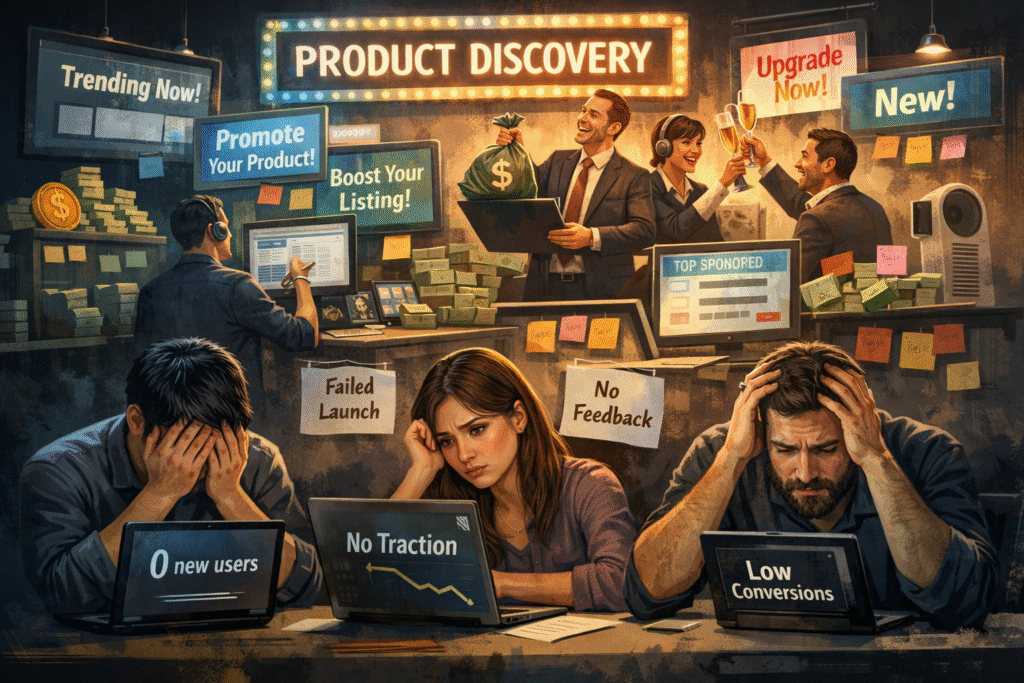
I get it. If you clicked on this blog, there’s a high chance you’re dealing with the same frustration most founders go through but rarely talk about openly. You’ve built something you genuinely believe in a new product that solves a real problem, something you’ve invested your time, energy, and focus into. And now you’re stuck wondering whether the issue is with your product itself or with the lack of exposure from product discovery platforms. That uncertainty can be frustrating, because from your perspective, everything seems right. The product works, the idea makes sense, and yet the traction just isn’t there.
This confusion usually starts right after your product launch. You put your product out there, maybe list it across multiple product discovery platforms, share it with your network, and wait for something meaningful to happen. At first, it looks promising. You might get some clicks, a bit of traffic, maybe even a small spike in activity. But when you look deeper, the results don’t match the expectations. The users don’t stick, conversions don’t happen, and whatever momentum you thought was building starts fading quickly. That’s when doubt starts creeping in, making you question whether your new product launch actually failed or if something else is going wrong.
The reality is that many founders go through this exact phase, and the problem is not always the product. In many cases, the issue lies in how product discovery actually works today. In theory, it sounds simple. You build a product, you list it on a platform, and people who need it discover it. But in practice, it doesn’t work that way. The system is not designed to connect the right users with the right products. Instead, it focuses heavily on visibility, which creates the illusion of progress without delivering real results. This highlights a deeper problem with product discovery platforms that many founders fail to recognize early in their journey.
In today’s digital ecosystem, launching a new product has become easier than ever. With access to no-code tools, global distribution channels, and fast development cycles, almost anyone can bring an idea to life. However, this ease of building has created another challenge, competition. Every day, hundreds of founders are going through their own product launch, trying to get attention on the same set of product discovery platforms. As a result, getting noticed has become significantly harder than building the product itself.
To solve this problem, a wide range of product discovery platforms have emerged, all promising to help startups gain visibility and attract users. On the surface, they appear to offer exactly what founders need. They provide exposure, engagement, and a structured way to present your product during a new product launch. For many founders, especially those launching for the first time, these platforms seem like the most logical and effective way to get started.
However, as more founders use these platforms, a pattern is becoming increasingly clear. While they do provide visibility, they often fail to deliver meaningful outcomes such as sustained user growth, high-quality feedback, or long-term traction. The traffic comes, but it doesn’t convert. The engagement happens, but it doesn’t lead to retention. And over time, this raises a deeper question about the effectiveness of these platforms.
Are product discovery platforms actually solving the problem of product discovery, or are they simply creating a temporary spike in attention that fades just as quickly as it appears? That’s exactly what we’re going to explore in this blog, by breaking down the real challenges founders face and the structural issues that continue to limit the effectiveness of modern product discovery systems.
This blog explores the problem with product discovery platforms in depth, analyzing the structural limitations that prevent them from delivering real value to startups in 2026 and why many product launches fail to achieve meaningful growth
The Misalignment Between Visibility and Product Discovery
One of the most fundamental issues with modern product discovery systems is the confusion between visibility and actual discovery. Many founders assume that if their product is seen by a large number of people, it will naturally lead to adoption. However, visibility alone does not guarantee that the right audience is being reached.
Most product discovery platforms operate on a feed-based model where multiple products are displayed simultaneously. This creates an environment where products compete for attention rather than relevance. Users browse through listings quickly, often without a clear intent to adopt a solution. As a result, even a well-designed new product may fail to attract meaningful engagement.
During a typical product launch, founders may observe a spike in traffic, but this traffic is often shallow. Users visit the page, glance at the product, and leave without taking any action. This behavior highlights a critical flaw in current product discovery mechanisms: they prioritize exposure over connection.
For product discovery to be effective, it must ensure that products are matched with users who have a genuine need for them. Without this alignment, visibility becomes a vanity metric rather than a growth driver.
The Audience Quality Problem
Another major problem with product discovery platforms is the quality of the audience they attract. While these platforms claim to bring in potential users, the reality is that a significant portion of their audience consists of other founders, marketers, and industry observers.
This creates a situation where products are being evaluated by individuals who may not represent the actual target market. For instance, a SaaS tool designed for enterprise clients may receive attention from independent developers or early-stage founders who are not in a position to use or purchase the product.
This mismatch leads to low conversion rates during a product launch. Founders may receive positive feedback and engagement, but this does not translate into user acquisition or revenue. As a result, the product discovery process becomes inefficient and misleading.
Oversaturation and the Decline of Attention
The rapid growth of the startup ecosystem has led to an overwhelming number of product launches. Every day, hundreds of founders introduce a new product across various platforms. While this reflects innovation, it also creates a significant challenge for product discovery.
Oversaturation reduces the visibility window for each product. On most product discovery platforms, new listings quickly push older ones down the feed. This means that a product launched today may lose visibility within hours.
For founders, this creates a highly competitive environment where attention is fragmented. Even a well-executed new product launch can struggle to maintain visibility long enough to generate meaningful traction.
This issue highlights a structural limitation of current product discovery platforms. They are designed to showcase a high volume of products but lack mechanisms to ensure sustained visibility for each listing. As a result, product discovery becomes a short-lived event rather than a continuous process.
This is another major problem with product discovery platforms that prevents startups from achieving consistent, long-term growth
Short-Term Exposure Without Long-Term Growth
One of the most commonly reported issues among founders is the short lifespan of a product launch on discovery platforms. Typically, a product receives the majority of its exposure within the first 24 hours. After this period, visibility drops significantly.
This short-term exposure model is fundamentally flawed. Building a successful product requires consistent engagement, user onboarding, and iterative improvement. A brief spike in traffic is not sufficient to achieve these objectives.
Effective product discovery should support long-term growth by continuously connecting products with new users. However, most product discovery platforms lack the infrastructure to facilitate ongoing discovery.
As a result, founders are forced to rely on repeated launches or external marketing efforts to maintain visibility. This increases the complexity of the product launch process and reduces the overall effectiveness of the platform.
Duplication of Product Hunt and Monetization-First Approach
One of the emerging and increasingly serious problems with product discovery platforms in 2026 is the duplication of existing models, particularly those inspired by Product Hunt.
In recent years, many new platforms have entered the market claiming to improve product discovery, but in reality, they follow almost identical structures. They replicate the same feed-based system, the same upvote mechanisms, and the same short-term visibility cycles.
At first glance, this seems like healthy competition. However, a deeper look reveals a different pattern.
Many of these platforms are not focused on genuinely improving the product discovery experience. Instead, they are primarily focused on monetization. Features such as paid promotions, premium listings, and sponsored placements are introduced early, often before the platform has even established a strong user base.
This creates a situation where the platform benefits more than the startups using it.
Founders are encouraged to invest time, effort, and sometimes money into their product launch, only to receive limited returns. The focus shifts from helping startups grow to maximizing platform revenue.
Interestingly, this concern is not just theoretical. You can find multiple real-world discussions where founders openly question the effectiveness of these platforms. In various startup communities, many users highlight how newer product discovery platforms are simply copies that prioritize monetization over meaningful discovery.
This trend weakens trust in the entire ecosystem. Instead of innovation, the space becomes saturated with similar tools that offer little differentiation. As a result, the overall quality of product discovery declines.
This clearly reflects a growing problem with product discovery platforms, where monetization is prioritized over delivering real value to startups.
Lack of Meaningful Feedback
Feedback is a critical component of any new product launch. It helps founders understand user needs, identify weaknesses, and refine their offerings. However, the feedback generated on most product discovery platforms is often superficial.
Comments tend to be generic and lack actionable insights. While positive feedback can boost morale, it does not contribute to product improvement. Founders need detailed input on usability, functionality, and value proposition.
The absence of meaningful feedback limits the effectiveness of product discovery. Without insights, founders cannot make informed decisions about product development or marketing strategy.
Dependence on Network and Influence
Another significant problem with product discovery platforms is the influence of social networks on product visibility. Products launched by founders with large followings or strong industry connections tend to receive more attention.
This creates an uneven playing field where success is influenced by network size rather than product quality. For new founders, this presents a major challenge. Even a highly innovative new product may struggle to gain visibility without external support.
This dependency undermines the core purpose of product discovery.
The Shift Toward Paid Visibility
As product discovery platforms evolve, many have introduced monetization strategies that prioritize paid visibility. Features such as sponsored listings and premium placements allow products to gain additional exposure.
While this approach generates revenue for the platform, it creates challenges for startups with limited budgets. Paid visibility can overshadow organic discovery, making it difficult for smaller teams to compete.
This shift raises concerns about the fairness of product discovery.
A Better Approach to Product Discovery: The Role of Foundigy
Given the limitations of traditional systems, it becomes clear that a new approach to product discovery is needed. This is where newer platforms like Foundigy are beginning to introduce a different perspective.
Instead of focusing solely on visibility during a product launch, Foundigy emphasizes continuous discovery and user relevance. The goal is not just to showcase a new product, but to ensure that it reaches users who are genuinely interested in it.
One of the key differences lies in how discovery is structured. Rather than relying purely on short-term trends or upvote systems, the platform encourages ongoing engagement. This allows startups to maintain visibility beyond the initial new product launch, creating opportunities for long-term growth.
Additionally, Foundigy focuses on meaningful interaction. Instead of surface-level engagement, it aims to create an environment where feedback is more actionable and relevant. This helps founders improve their products based on real insights rather than generic responses.
Another important aspect is accessibility. Unlike many platforms that lean heavily toward paid visibility, Foundigy is designed to give startups a fair chance to be discovered based on value. This helps restore balance in the product discovery process.
While no platform is perfect, approaches like this indicate a shift in how product discovery platforms can evolve to better serve startups.
Conclusion
The rise of product discovery platforms has significantly influenced how startups approach a product launch. These platforms have made it easier to introduce a new product to a global audience. However, as the ecosystem matures, their limitations have become increasingly clear.
From audience misalignment and oversaturation to short-term visibility and monetization-focused models, the problem with product discovery platforms is deeply rooted in their design. These challenges prevent founders from achieving meaningful and sustainable growth.
To succeed in 2026, startups must rethink their approach to product discovery. Instead of relying solely on traditional platforms, they should focus on strategies that prioritize relevance, engagement, and long-term visibility.
At the same time, the industry itself must evolve. The next generation of product discovery platforms must move beyond simple listings and short-term exposure. They must focus on creating systems that connect the right products with the right users, at the right time.
Ultimately, the problem with product discovery platforms lies in their inability to deliver consistent, meaningful results for startups beyond initial visibility.
Because ultimately, true product discovery is not about being seen—it is about being understood, adopted, and used.