Product Hunt Launch: My Honest Experience as a Founder
Launching a startup is one of the most exciting moments for any founder. You spend weeks or months building a product, refining its features, improving the interface, and finally preparing to introduce it to the world. But building a product is only half the journey. The real challenge begins when you try to get people to discover it. In today’s startup ecosystem, thousands of new tools, SaaS products, and apps are launched every single month. With so many options available, gaining visibility has become one of the hardest problems for founders.
For years, one platform has been widely known as the place where startups introduce their products to the world: Product Hunt.
Many founders believe that a Product Hunt launch is the best way to gain early traction. The idea sounds appealing. You launch your product, the community discovers it, users give feedback, and if everything goes well, your product climbs the rankings and receives attention from early adopters, investors, and tech enthusiasts. That belief is exactly why I decided to try it myself.
Like many founders, I assumed that launching my product on the platform would naturally bring visibility. My niche is product discovery, which is closely aligned with the community itself. Because of that, I believed my Product Hunt launch would be a natural fit. However, once I went through the entire process, my experience revealed a very different reality.
This article shares my Product Hunt launch experience as a founder, the expectations I had before launching, what actually happened during the launch, the challenges I noticed on the platform, and why I eventually started thinking about better alternatives for product discovery.
Why Founders Choose a Product Hunt Launch
Before talking about my own experience, it’s important to understand why so many founders consider a Product Hunt launch in the first place. Product Hunt is a well-known website where new startups, tools, and digital products are introduced to a community of early adopters. Every day, new products appear on the platform and users can explore them, leave comments, and give feedback. The platform uses a simple mechanism: upvotes.
When users like a product, they upvote it. Products with the highest upvotes move toward the top of the rankings. Those that reach the top receive the most visibility. For founders, this system appears fair and exciting. It feels like a place where innovative ideas can compete equally.
Because of this reputation, many founders believe that launching there will help them gain:
- early users
- product feedback
- industry visibility
- social proof
- potential investors
This expectation is what motivates thousands of startups to attempt a Product Hunt launch every year.
Preparing for My Product Hunt Launch
Before launching my product, I spent time researching how successful launches happen. Most guides on Product Hunt launch strategy suggest several preparation steps. These steps include designing attractive visuals, writing a strong product tagline, creating screenshots that clearly explain the product, and preparing a detailed founder comment to introduce the product to the community.
Another important factor many founders discuss is timing. Many guides recommend choosing the best time to launch on Product Hunt, often around midnight Pacific Time when a new product cycle begins on the platform.
Following this advice, I prepared carefully for my Product Hunt launch. I created clear visuals, wrote a description explaining the value of the product, and ensured that everything looked professional. Because my product focuses on product discovery, I believed that launching on a platform centered around discovery would attract attention from users interested in the same niche.
Everything looked ready. Finally, the day of my Product Hunt launch arrived.
My Product Hunt Launch Experience
The moment you launch a product on the platform is exciting. You watch the page, refresh the rankings, and hope to see engagement building over time. At first, I expected that the community would gradually discover my product and begin interacting with it. But within a short period of time, I began noticing a pattern during my Product Hunt launch.
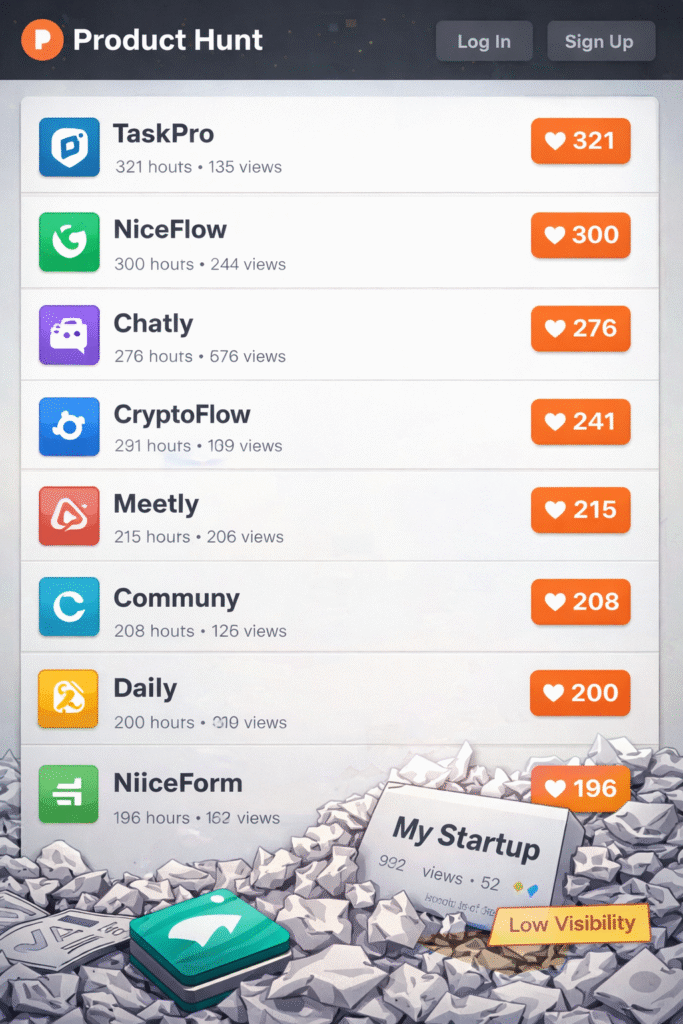
Some products were gaining large numbers of upvotes almost immediately. Their ranking increased rapidly and they quickly appeared at the top of the platform. Meanwhile, many other products struggled to gain visibility. Initially, I assumed that those top products were simply better or more interesting. But as I observed the activity during my Product Hunt launch, another explanation became obvious.
Many of the products performing well already had strong audiences outside the platform.
The founders had large Twitter followings, startup communities, or mailing lists ready to support their launch. When those audiences arrived and began upvoting the product, it quickly climbed the rankings.
Once a product reached the top positions, it became even more visible and continued gaining momentum. Meanwhile, products that didn’t receive early support began falling lower in the rankings. This created a noticeable gap during my Product Hunt launch between products with large audiences and those without them.
The Visibility Challenge
One major issue I noticed during my Product Hunt launch was the way visibility works on the platform. Products that receive early upvotes gain more exposure because they move toward the top of the ranking list. Users browsing the platform are more likely to see those products first.
This creates a snowball effect. Products at the top receive more views, more views lead to more upvotes, and more upvotes push the product even higher. However, products that start slowly face the opposite situation.
During my Product Hunt launch, I noticed that products with fewer upvotes gradually moved down the list and eventually became buried under newer launches. Once that happens, it becomes extremely difficult to regain visibility. This system means that the success of a Product Hunt launch often depends heavily on the first few hours after launching. If a product gains traction early, it has a chance to succeed. If not, it may quickly disappear from attention.
Product Hunt Is Becoming Over Saturated
Another issue that became obvious during my Product Hunt launch was the level of competition on the platform. Every day, dozens of products launch. Over time, this has created an environment where the platform is extremely saturated.
Because so many founders attempt a Product Hunt launch, the number of products competing for attention has increased significantly. This saturation creates two challenges. First, the competition for visibility becomes intense. Even good products may struggle to stand out among the large number of launches happening every day.
Second, the platform becomes crowded with similar tools and startups, making it harder for users to explore every product. During my Product Hunt launch, it became clear that many products were simply lost in the noise. The idea of organic discovery becomes difficult when there are too many products competing at the same time.
For founders hoping that the platform will automatically bring exposure, this oversaturation can lead to disappointment, you can check out this list of Product Hunt alternatives for founders in 2026.
The Cost of Attention
Another reality that founders may discover during a Product Hunt launch is that visibility often requires significant promotion. Many successful launches rely heavily on external marketing efforts.
Founders may:
- mobilize their social media audiences
- activate communities
- encourage friends and colleagues to support the launch
- promote the launch across multiple channels
All of these efforts bring external traffic to the platform. When that audience begins upvoting the product, it quickly gains ranking momentum. From the outside, it appears that the platform itself generated the success. But in reality, the Product Hunt launch was powered primarily by external audiences.
For founders without large communities, competing in this environment can be challenging.
Product Hunt Copy Models
While researching launch platforms, I also explored many other product discovery websites. Interestingly, most of them follow almost exactly the same structure as Product Hunt. These platforms often replicate the same model: Products are listed on a page, users can upvote them, and rankings determine which products receive visibility.
At first glance, this seems logical because the model has already proven popular.
However, it also creates the same problems everywhere. Instead of focusing on genuine discovery, these platforms become competition-driven ecosystems where founders compete for upvotes. During my research, it became clear that many of these platforms are essentially copies of the Product Hunt system.
They replicate the same ranking mechanics, the same upvote structure, and the same competition dynamics. But this raises an important question. If every platform follows the same system, are founders actually gaining any new visibility? Or are they simply participating in another ranking contest? I explained these issues in more detail in this article about the biggest problems with product discovery platforms in 2026.
The Visibility Illusion
Many founders join product discovery platforms hoping for exposure. The expectation is simple: submit your product, and the platform will help people discover it. However, the reality often looks different.
Because these platforms depend heavily on rankings and upvotes, products that gain early traction dominate the visibility. Meanwhile, other products receive very little attention.
During my Product Hunt launch, I realized that the platform functions more like a competition leaderboard than a pure discovery engine. The system rewards products that already have audiences while making it harder for smaller founders to gain attention. This doesn’t mean the platform is useless.
But it does mean that founders should understand the limitations of relying entirely on a single Product Hunt launch for visibility. Many founders are now exploring alternative launch ecosystems designed to improve discoverability and long-term exposure, which I discussed in detail in my article about why new product launch platforms matter in 2026.
Introducing Foundigy
After experiencing these challenges and studying the structure of many product discovery platforms, I started thinking about a different approach. That idea eventually led to the creation of Foundigy.
Foundigy was designed with one primary goal: to give founders fair and equal visibility. Instead of focusing entirely on upvotes and ranking battles, Foundigy emphasizes discoverability and search visibility.
One of the biggest differences is the use of SEO-focused listings.
When founders submit their products on Foundigy, they can integrate keywords that describe what their product actually does. This allows the platform to match products with real search intent. For example, imagine someone searching for a solution like AI video editor. Instead of browsing through hundreds of ranked listings, they can find products that specifically match that search. This approach helps founders reach users who are actively looking for their type of product.
Another key aspect of Foundigy is the focus on fairness. Every founder receives equal listing opportunities, meaning visibility is not limited only to those with massive audiences or large marketing campaigns.
The goal is simple: help startups get discovered by people who genuinely need their products. For founders building innovative tools, this kind of visibility can be far more valuable than simply competing for upvotes.
Why Product Discovery Needs a New Approach
The startup ecosystem continues to grow rapidly. Every year, thousands of new tools, apps, and platforms are built by founders around the world. As this ecosystem grows, the need for effective product discovery platforms becomes even more important. Traditional ranking-based systems, like those used during a Product Hunt launch, have played an important role in startup culture.
But the increasing saturation of launches shows that new models may be needed. Platforms that focus on search visibility, discovery, and fair exposure could provide better opportunities for founders, especially those who are just starting their journey.
Instead of relying solely on upvotes and ranking competitions, discovery platforms can evolve to prioritize real user intent and meaningful exposure.
Final Thoughts on My Product Hunt Launch
My Product Hunt launch was an interesting learning experience. The platform has a strong community and a long history in the startup world. Many successful products have launched there and gained recognition. However, my personal Product Hunt launch experience revealed several realities that founders should consider before relying entirely on the platform.
First, the competition on the platform is extremely high because of the large number of daily launches.
Second, products with strong external audiences often gain an advantage during a Product Hunt launch.
Third, the ranking system tends to concentrate visibility on a small number of products while others receive little exposure.
Finally, the growing saturation of launches makes organic discovery increasingly difficult.
For founders preparing their own Product Hunt launch, the most important lesson is simple: do not rely on a single platform for visibility. Explore multiple discovery platforms, directories, and marketing channels to introduce your product to the right audience. Because in the end, the success of a product launch depends not only on where you launch, but on how effectively your product reaches the people who actually need it.