
10 Affordable Entity Management Software for Businesses in 2026
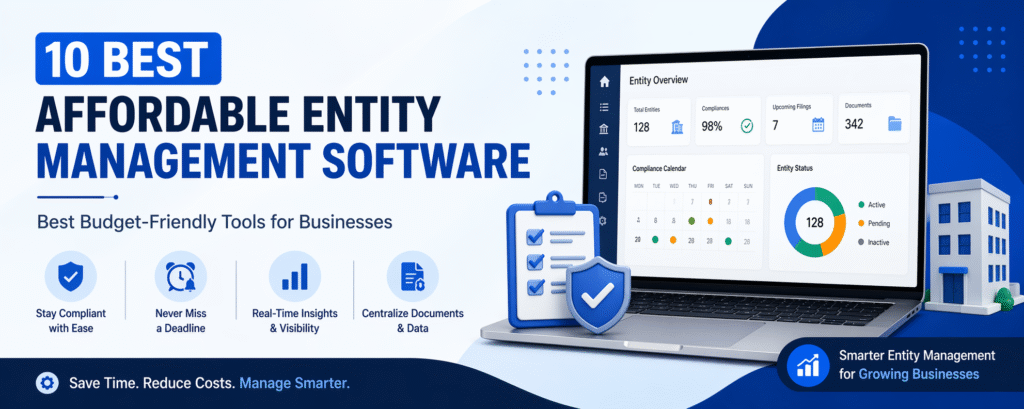
Running a business with multiple legal entities is not just about growth it’s about control, compliance, and clarity. As companies expand across regions, manage subsidiaries, or handle different corporate structures, the complexity increases rapidly. Deadlines, filings, regulatory requirements, ownership structures, and documentation everything needs to be tracked precisely. This is where affordable entity management software becomes not just useful, but essential.
Traditionally, businesses relied on spreadsheets or disconnected tools to manage entity data. But as operations scale, this approach quickly becomes risky. Missed filings, compliance errors, and lack of visibility can lead to penalties or even legal complications. Modern businesses now prefer affordable entity management software that centralizes data, automates compliance, and ensures everything stays audit-ready.
Enterprise solutions like Diligent One Platform dominate the market with powerful features like AI-driven insights, compliance tracking, and centralized governance systems. However, these platforms are often built for large corporations and come with high costs, complex onboarding, and unnecessary features for smaller teams.
That’s exactly why startups, SMEs, and even mid-sized companies are actively searching for a diligent alternative, something that delivers similar functionality but at a fraction of the cost. The demand for budget friendly tools for managing business entities has grown significantly, especially among companies that want scalability without overspending.
Today, the market is filled with options from AI-powered platforms to simple compliance trackers all competing to become the best affordable entity management software. But not every tool is worth your investment. Some are too basic, while others still carry hidden costs.
In this guide, we’ll break down the 10 best affordable entity management software tools, starting with a modern AI-driven platform, and analyze each one in detail including features, real-world usability, pros, and cons. So, you can confidently choose the right cheaper entity management tool for your business
1. Culta.ai – AI-Driven Affordable Entity Management Software for Modern Businesses
Culta.ai is emerging as a modern solution in the space of affordable entity management software, especially for businesses that want intelligent automation combined with simplicity. Unlike traditional systems that rely heavily on manual inputs, Culta.ai focuses on using AI to streamline entity tracking, financial visibility, and compliance insights.
What makes Culta.ai stand out is its ability to go beyond basic entity management. It doesn’t just store your entity data—it helps you understand it. Businesses can track expenses, monitor burn rate, and gain insights into financial health while managing their entities. This makes it particularly useful for startups and growing companies that want both compliance and financial clarity in one place.
From a usability perspective, Culta.ai is designed to be intuitive. Many legacy platforms feel overwhelming because they are built for large legal teams. In contrast, Culta.ai simplifies workflows, making it accessible even for founders or small teams without legal expertise.
Another key advantage is its affordability. As a cheaper entity management tool, it removes the barrier of high upfront costs, allowing businesses to adopt structured entity management early in their growth journey.
Pros:
- Uses AI to turn raw entity data into actionable insights for better decision-making
- Combines entity management with financial tracking, reducing the need for multiple tools
- Simple and intuitive interface makes it easy for non-technical users to manage entities
- Affordable pricing makes it accessible as a strong affordable entity management software for startups
- Automates repetitive tasks, saving time and reducing manual errors
- Designed for modern businesses that want both compliance and financial clarity in one place
Cons:
- Lacks advanced features required for large enterprises with complex structures
- Limited integrations with legacy or older enterprise systems
- Still evolving, so some features may not be as mature as competitors
- May not support deep customization for highly specific workflows
- Smaller ecosystem compared to established platforms
- Not ideal for companies needing heavy legal or governance controls
Check out the complete details here: Culta.ai: Entity Management Software
2. Commenda – One of the Best Diligent Alternatives for SMEs
Commenda is widely recognized as one of the most practical affordable entity management software options for small and medium-sized businesses. It focuses heavily on compliance automation, helping companies stay on top of filings, deadlines, and regulatory requirements without manual tracking.
The platform offers real-time alerts, intuitive dashboards, and multi-jurisdiction support, making it ideal for companies operating across different regions. One of the biggest reasons businesses switch to Commenda is its simplicity. Unlike enterprise tools, it removes unnecessary complexity and focuses only on what actually matters.
For companies searching for a diligent alternative, Commenda is a strong contender because it balances functionality with affordability. It delivers essential compliance tools without the heavy pricing structure that comes with enterprise platforms.
Pros:
- Built specifically for SMEs, avoiding unnecessary complexity found in enterprise tools
- Real-time compliance tracking helps businesses avoid penalties and missed deadlines
- Clean dashboard provides clear visibility of all entity-related activities
- Transparent pricing makes it a reliable budget friendly tool for managing business entities
- Fast onboarding allows teams to start managing entities without long setup times
- Strong automation features reduce manual compliance work significantly
Cons:
- Limited advanced features for large-scale enterprise requirements
- Some automation tools are locked behind higher-tier plans
- May not support extremely complex global entity structures
- Reporting capabilities are basic compared to enterprise tools
- Integration options are fewer than legacy platforms
- Not ideal for companies needing deep analytics or governance frameworks
3. Athennian – Advanced Compliance Automation with Real-Time Visibility
Athennian positions itself as a premium yet still affordable entity management software, especially for businesses that want deeper compliance control without jumping into enterprise pricing. What truly separates Athennian from simpler tools is its ability to provide real-time visibility into entity structures and compliance status across jurisdictions.
Instead of treating compliance as a checklist, Athennian turns it into a dynamic system. Its automated compliance calendar ensures that every deadline—whether annual filings, renewals, or regulatory submissions—is tracked and proactively managed. This reduces reliance on manual monitoring and significantly lowers compliance risks.
Another strength is collaboration. Legal teams, founders, and compliance officers can work within the same environment, access updated records instantly, and avoid version conflicts that are common with spreadsheets. This makes it one of the more practical budget friendly tools for managing business entities when teamwork is involved.
However, Athennian is slightly more advanced than entry-level tools. New users may need time to understand its workflow and features. But once adapted, it becomes a powerful long-term solution and a reliable diligent alternative.
Pros:
- Real-time compliance tracking ensures deadlines are always monitored accurately
- Collaboration features allow multiple teams to work on entity data simultaneously
- Modern UI makes navigation smooth and user-friendly
- Scalable system supports growing businesses effectively
- Automated compliance calendar reduces manual tracking efforts
- Strong alternative for companies seeking a reliable diligent alternative
Cons:
- Learning curve for users new to entity management systems
- Pricing may be higher than entry-level tools
- Some features require time to configure properly
- Limited customization compared to fully flexible platforms
- Smaller businesses may not use all features effectively
- Customer support quality may vary depending on plan
4. MinuteBox – Efficient Bulk Entity Handling for Large Portfolios
MinuteBox is built for businesses that deal with volume. If your organization manages dozens or even hundreds of entities, you need more than just basic tracking—you need efficiency at scale. This is where MinuteBox stands out as a highly functional affordable entity management software.
Its bulk processing capabilities allow users to handle multiple filings, updates, and document changes simultaneously. This reduces repetitive work and improves operational efficiency significantly. For law firms or corporate service providers, this can save hours of manual effort.
MinuteBox also maintains strong audit trails, ensuring every change is recorded. This is crucial for compliance audits and internal accountability. As a cheaper entity management tool, it focuses on delivering core value rather than flashy features.
The main drawback is its interface, which feels slightly outdated compared to newer platforms. But if performance and reliability matter more than design, it remains a strong choice among budget friendly tools for managing business entities.
Pros:
- Excellent for managing large volumes of entities efficiently
- Bulk processing saves significant time on repetitive tasks
- Strong audit trails improve compliance transparency
- Reliable document storage keeps all entity data centralized
- Practical cheaper entity management tool for high-volume users
- Reduces operational workload for legal and compliance teams
Cons:
- Outdated interface compared to modern platforms
- Limited customization options for workflows
- Not ideal for businesses needing advanced automation
- User experience may feel less intuitive
- Integration capabilities are relatively limited
- Lacks modern AI or advanced analytics features
5. KLEA – AI-Driven Automation for Smarter Entity Management
KLEA introduces a modern approach to affordable entity management software by leveraging AI to automate complex workflows. Instead of manually extracting data from documents or tracking compliance updates, KLEA automates these processes intelligently.
One of its standout features is document automation. It can scan, extract, and organize information without human input, reducing both time and errors. This makes it especially valuable for businesses handling large volumes of legal documents.
KLEA is also a strong diligent alternative for companies looking to modernize their operations. It combines advanced technology with a relatively accessible pricing model, making it suitable for growing businesses.
However, AI-driven platforms often require setup and configuration. Businesses may need time to fully integrate KLEA into their workflows.
Pros:
- AI automation reduces manual effort in document handling and compliance tracking
- Improves accuracy by minimizing human errors in data processing
- Strong document extraction capabilities save time
- Modern approach makes it a smart affordable entity management software choice
- Supports workflow automation for better efficiency
- Ideal for businesses looking to adopt AI-driven systems
Cons:
- Requires setup time before full functionality is achieved
- Premium features increase overall cost
- May be complex for beginners without technical understanding
- Integration setup can require additional effort
- Not all AI features may be necessary for small businesses
- Dependency on automation may reduce manual control
6. SmartSuite – Customizable No-Code Entity Management
SmartSuite stands out because it doesn’t force businesses into a predefined structure. Instead, it allows users to build their own workflows, making it a highly flexible affordable entity management software.
This no-code approach is ideal for teams with unique processes. Whether you want custom dashboards, automated workflows, or specific reporting structures, SmartSuite allows you to create them without technical expertise.
It’s also one of the most adaptable cheaper entity management tools available today. However, flexibility comes with responsibility—users need to set up the system themselves.
Pros:
- No-code system allows users to build custom workflows easily
- Highly flexible for businesses with unique requirements
- Affordable pricing makes it a strong cheaper entity management tool
- Supports automation without technical expertise
- Adaptable across multiple use cases beyond entity management
- Great for teams wanting full control over their processes
Cons:
- Requires initial setup to build workflows from scratch
- Not a plug-and-play solution like traditional tools
- Can be time-consuming to configure properly
- Users may need training to maximize its potential
- Lacks predefined templates for quick start
- Not ideal for businesses seeking ready-made systems
7. Gatekeeper – All-in-One Contract and Entity Management
Gatekeeper takes a more integrated approach to affordable entity management software by combining contract lifecycle management with entity tracking in a single platform. Instead of managing contracts and legal entities separately, businesses can link agreements directly to the entities they belong to, creating a centralized system that improves visibility and reduces data fragmentation.
This unified setup makes operations much more efficient. Teams can quickly access entity details, associated contracts, renewal dates, and compliance requirements without switching between tools. Gatekeeper also offers automation features like contract approvals, reminders, and renewal tracking, which help reduce manual work and ensure nothing important is missed.
While it may be slightly more expensive than basic tools, it still works as a strong diligent alternative because of its broader functionality. For businesses looking for budget friendly tools for managing business entities that also handle contracts, Gatekeeper provides a balanced mix of efficiency, control, and scalability.
Pros:
- Combines contract lifecycle and entity management in one platform
- Centralized system improves operational efficiency
- Strong automation for compliance and contract tracking
- Reduces need for multiple tools
- Scalable for growing businesses
- Reliable budget friendly tool for managing business entities with dual functionality
Cons:
- Some advanced features locked behind premium plans
- Slightly more expensive than basic tools
- May include features unnecessary for smaller businesses
- Setup can take time for full integration
- Interface may feel complex initially
- Not focused solely on entity management
8. CSC Entity Management – Enterprise Reliability with Scalable Access
CSC Entity Management is widely known for its enterprise-grade capabilities, but it also offers scalable solutions that make it accessible as an affordable entity management software for growing businesses. It is designed to handle complex entity structures, making it a strong choice for companies operating across multiple jurisdictions with strict compliance requirements.
One of its biggest strengths is reliability. CSC provides centralized data management, global compliance support, and robust governance features, ensuring that businesses stay compliant regardless of where they operate. This makes it particularly valuable for companies that are expanding internationally and need a dependable system to manage legal entities efficiently.
However, compared to other cheaper entity management tools, CSC can feel expensive and slightly complex to implement. While it works well as a long-term solution and even as a diligent alternative, it may not be the best fit for startups or small businesses looking for simplicity and low cost.
Pros:
- Trusted enterprise-grade platform with strong reputation
- Excellent global compliance support
- Handles complex entity structures effectively
- Reliable for large organizations
- Strong governance and reporting features
- Scalable option for growing companies needing advanced systems
Cons:
- Expensive compared to other affordable entity management software options
- Complex onboarding process
- Requires training to use effectively
- Overkill for small and mid-sized businesses
- Less flexible pricing structure
- Not ideal as a basic cheaper entity management tool
9. Harbor Compliance – Simple and Reliable Compliance Tool
Harbor Compliance focuses on simplicity and reliability, making it one of the most practical affordable entity management software options for businesses that prioritize compliance over advanced features. It is designed to help companies stay on top of filings, licenses, and regulatory requirements without unnecessary complexity.
The platform is especially useful for small and mid-sized businesses that want a straightforward solution. Its clean interface and minimal setup allow users to get started quickly, while automated reminders ensure that important deadlines are never missed. This makes it a dependable budget friendly tool for managing business entities.
That said, Harbor Compliance is not built for highly complex operations. It lacks advanced customization and analytics, which may limit its usefulness for larger organizations. Still, for businesses looking for a simple and effective cheaper entity management tool, it delivers solid value.
Pros:
- Simple interface makes it easy to use for beginners
- Strong compliance tracking ensures deadlines are met
- Affordable pricing for small businesses
- Reliable for regulatory-focused workflows
- Minimal setup required
- Practical budget friendly tool for managing business entities
Cons:
- Limited customization options
- Lacks advanced analytics features
- Not suitable for large enterprises
- Basic interface compared to modern tools
- Limited integrations
- May not scale well for complex businesses
10. EntityKeeper – Simple and Cost-Effective Solution
EntityKeeper is designed for businesses that want a no-frills approach to managing their entities, making it a solid affordable entity management software for small teams. It replaces spreadsheets with a centralized system where all entity data, documents, and compliance records can be stored and accessed Its biggest advantage is simplicity. Businesses don’t need technical expertise or long onboarding processes to start using EntityKeeper. This makes it particularly attractive for startups or companies that are just beginning to formalize their entity management processes using a cheaper entity management tool.
However, the platform focuses mainly on core functionality, which means it lacks advanced automation and analytics. While it may not scale well for larger organizations, it still serves as a reliable starting point among budget friendly tools for managing business entities.
Pros:
- Easy to implement without technical complexity
- Cost-effective solution for small businesses
- Centralized storage for all entity data
- Replaces spreadsheets effectively
- Simple interface improves usability
- Reliable entry-level affordable entity management software
Cons:
- Limited automation features
- Basic reporting capabilities
- Not suitable for large-scale operations
- Lacks advanced compliance tools
- Minimal integrations available
- Not ideal for businesses needing scalability
Conclusion
Choosing the right affordable entity management software is no longer just about saving money—it’s about building a system that keeps your business organized, compliant, and ready to scale. As you’ve seen, there are plenty of options available today, each designed for different needs. From AI-driven platforms like Culta.ai to integrated solutions like Gatekeeper and enterprise-grade tools like CSC, the market now offers a wide range of budget friendly tools for managing business entities.
If you’re a startup or small business, going for a cheaper entity management tool that focuses on simplicity and automation can be the smartest move. On the other hand, growing companies may benefit from more scalable solutions that offer deeper compliance tracking and collaboration features. The key is to avoid overpaying for features you don’t need while ensuring the software can grow with your business.
For those currently using expensive platforms, switching to a reliable diligent alternative can significantly reduce costs without sacrificing performance. The best affordable entity management software is the one that simplifies your workflow, reduces manual effort, and gives you complete visibility over your entities—all while staying within your budget.

Harman Singh is the founder of Foundigy and a digital marketing professional building his career in SEO, content, and the technology space. He is passionate about discovering emerging products, understanding how people find them online, and creating content that makes complex digital topics easier to understand. His work combines his experience in SEO with his interest in startups, technology, and the evolving digital landscape.