The Biggest Product Launch Platform in 2026
The startup ecosystem has evolved faster in the last few years than it did in the previous decade. Today, launching a product is no longer the biggest challenge. With the rise of AI tools, no-code platforms, and global accessibility to development resources, almost anyone can build and launch a startup with minimal friction. What once required months of planning and execution can now be achieved in a matter of days. However, this ease of building has created a new and far more complex problem, overcrowding and lack of real validation across every product launch platform.
Every single day, thousands of products are launched across multiple product launch platform websites. Founders enter the ecosystem with excitement, ambition, and a clear goal in mind: to get users, validate their idea, and grow. But what actually happens after launch is often very different from what they expect. Instead of gaining meaningful traction, many startups get lost in a sea of other launches. Instead of receiving useful insights, they receive surface-level engagement. And instead of achieving clarity, they are left with confusion.
This disconnect between expectation and reality is not accidental. It is deeply rooted in how modern product launch platform systems are designed. In 2026, the biggest product launch platform will not be the one that simply showcases products it will be the one that solves this fundamental disconnect and helps founders achieve what they actually set out to do: gain users, validate ideas, and build something that works.
The Core Problem with Every Product launch Platform Today
Most product launch platform systems today follow a very similar structure. A founder submits their product, the platform displays it alongside other launches, and users interact through upvotes or engagement signals. On the surface, this seems like a fair and democratic system. However, when examined closely, it reveals a number of critical flaws that directly impact the success of early-stage startups.
One of the biggest issues is that many startup launch platform solutions have simply adopted a ranking-based model without innovation. Instead of rethinking how product discovery and validation should work, they replicate the same mechanics—upvotes, rankings, and short-lived visibility cycles. This has led to a situation where multiple platforms offer the same experience with minimal differentiation. Founders are essentially launching into slightly different versions of the same product launch platform, expecting different results.
This replication creates a saturated environment where originality in platform design is almost non-existent. More importantly, it reinforces a flawed system where success is determined by visibility spikes rather than sustained value.
Why Your Product Gets Buried on a Product Launch Platform
Founders launch their products with a clear intention—to get users, gather feedback, and create momentum. But what actually happens on most product launch platform websites is that their launch gets overshadowed almost immediately by higher-ranked products.
When a startup goes live, it is placed alongside dozens, sometimes hundreds, of other launches. Within hours, products that receive early traction begin to dominate the rankings. These high-vote startups attract more attention, which leads to even more engagement, creating a compounding effect. Meanwhile, newer or less-promoted startups get pushed down the list, often without receiving any meaningful exposure at all.
This creates a major structural problem within every product launch platform. Even if a startup has potential, it may never get the opportunity to be evaluated properly because it is buried under more popular listings. The system does not reward quality, it rewards momentum.
This is exactly why many founders feel that their launch failed before it even started. Not because their idea was weak, but because the product launch platform they used was not designed to give equal opportunity.
The Illusion of Success on a Product Launch Platform
On the other side, startups that do manage to gain visibility on a product launch platform often fall into a different trap, the illusion of success. When a product receives upvotes, comments, or shares, it creates a sense of achievement. Founders interpret this engagement as validation, believing that their idea is working.
However, this engagement is often superficial. Users interact with products based on presentation, trends, or social influence rather than genuine intent to use or pay for the product. A well-designed landing page or a trending concept can generate attention, but that attention does not necessarily translate into real users.
This creates a dangerous gap between perceived success and actual performance. Founders continue building based on signals that are not rooted in real demand, only to realize later that their product does not resonate with users in the real world.
Why Most Product Launch Platforms are Failing?
The reason most product launch platform systems continue to rely on these flawed mechanics is simple; they are easy to scale. Upvotes, rankings, and engagement metrics are straightforward to implement and effective at driving user activity. They create a sense of competition and urgency, which keeps users coming back.
However, scalability does not equal effectiveness. What works for platform growth does not necessarily work for founder success. And this misalignment is at the heart of the problem with every major startup launch platform today.
As more platforms continue to copy the same model, the need for a fundamentally different approach becomes increasingly clear.
Introducing Foundigy the Future Product Launch Platform
Foundigy is built on the understanding that founders do not launch products just for attention. They launch with the intention of gaining users, understanding their market, and building something that works.
Instead of focusing on short-term visibility like a traditional product launch platform, Foundigy is designed to support long-term growth by addressing the core problems that others ignore. It does not replicate existing systems. Instead, it redefines what a product launch platform should be.
1. SEO-Focused Listings: Redefining the Product Launch Platform
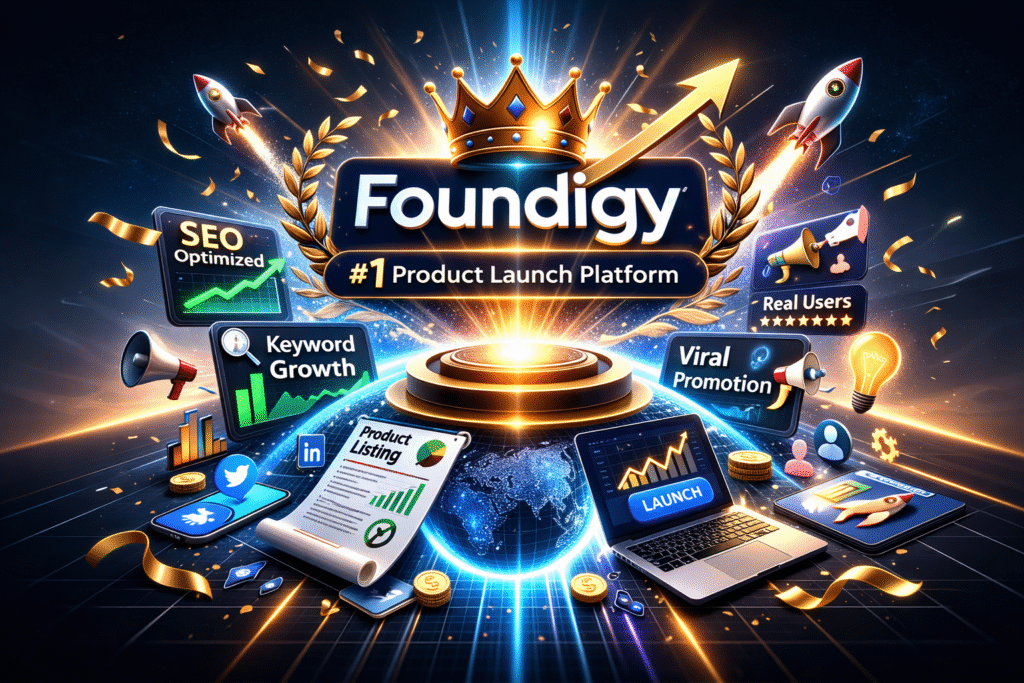
One of the most powerful features of Foundigy as a product launch platform is its focus on SEO-driven listings. Unlike traditional platforms where a product’s visibility disappears within hours or days, Foundigy ensures that listings are optimized for search engines from the beginning.
This means that when a founder launches a product, they are not just targeting platform users—they are building a presence that can attract traffic over time. Keywords like product launch platform, biggest product launch platform, and startup launch platform are naturally integrated into listings, allowing products to rank for relevant searches.
This transforms the launch from a short-term event into a long-term asset. A well-optimized listing can continue to bring users weeks or even months after the initial launch.
2. Keyword Integration: A Smarter Product Launch Platform Strategy
Another critical aspect of Foundigy is its emphasis on keyword integration. A modern product launch platform should not just display products—it should help founders align with real user intent.
By focusing on keywords, Foundigy helps founders understand how their product fits into the broader market. Instead of random visibility, founders gain targeted exposure.
This ensures that every launch on the platform is not just seen—but seen by the right audience.
3. Storytelling: The Missing Layer in Every Product Launch Platform
Most product launch platform listings are shallow. They focus on short descriptions that aim to capture attention quickly. Foundigy changes this by introducing storytelling-driven listings.
Founders are encouraged to explain why they built their product, what problem they faced, and how their solution works. This adds depth and creates a stronger connection with users.
A product launch platform should not just showcase products—it should communicate vision. And storytelling is the most powerful way to achieve that.
4. A Fair Product Launch Platform for Every Startup
One of the biggest improvements Foundigy brings is fairness. Unlike traditional systems where a few products dominate, this product launch platform ensures balanced exposure.
Every startup gets a chance to be seen. Every idea gets a chance to be evaluated. And every founder gets a chance to grow.
This is what truly defines the biggest product launch platform not size, but impact.
How Foundigy Solves the Biggest Product Launch Problems
Foundigy addresses the core issues of traditional platforms by fundamentally rethinking what a product launch platform is supposed to do. Instead of treating a launch as a one-day event driven by competition, rankings, and temporary hype, it shifts the focus toward clarity, positioning, and long-term growth. This shift is important because most founders are not launching their products to win a daily leaderboard, they are launching to understand whether their idea works, attract real users, and build something sustainable.
One of the biggest problems with any traditional product launch platform is its dependence on short-term engagement. The entire system is designed around immediate traction—how many upvotes a product gets, how quickly it gains attention, and how well it performs within a limited time window. Foundigy removes this dependency by designing a system where visibility is not tied to a single moment. Instead, it transforms every launch into a long-term asset. When a founder lists their product, they are not just publishing it for a few hours of exposure, they are creating a page that can continuously attract users through search, discovery, and relevance over time.
This is where SEO-focused listings play a critical role. Unlike a typical product launch platform where listings lose visibility almost instantly, Foundigy ensures that every listing is structured in a way that search engines can understand and rank. This means founders are no longer dependent only on platform traffic. Their product can be discovered by users actively searching for solutions, even weeks or months after the launch. This approach directly solves the problem of “launch and disappear,” which is one of the most frustrating experiences for early-stage founders.
Conclusion: The Future of the Biggest Product Launch Platform
The definition of the biggest product launch platform is rapidly changing. It is no longer about which product launch platform can generate the most noise, attract the most upvotes, or create the biggest product launch moment for a single day. Instead, the focus is shifting toward platforms that can consistently help founders achieve real outcomes—getting users, validating ideas, and building sustainable businesses. As more founders recognize the limitations of traditional systems, the demand for a smarter product launch platform continues to grow, one that prioritizes long-term visibility over short-term spikes, real user intent over vanity metrics, and clarity over competition. This shift is also shaping the future of every startup launch platform, pushing them to move beyond copied models and toward meaningful innovation.
Foundigy aligns perfectly with this new direction by solving the core problems that most product launch platform models ignore. Through SEO-focused listings, keyword integration, and storytelling-driven positioning, it transforms how products are launched and discovered. Instead of relying on temporary attention, it builds a system for continuous growth and real user acquisition. This is what positions Foundigy as a strong contender for the biggest product launch platform in 2026 not by creating hype, but by delivering lasting value where it truly matters.
Want to explore further? Check out these articles for deeper strategies and growth tips